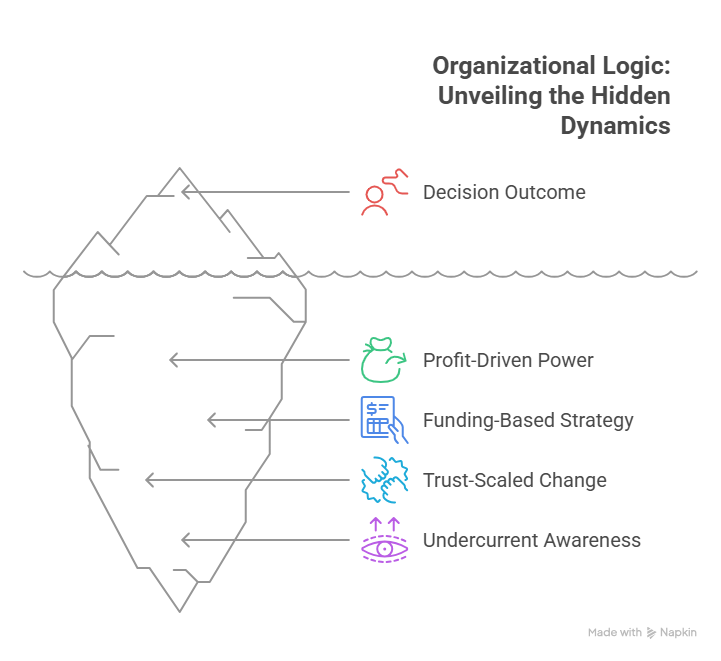
In every company, there are two rulebooks.
The official one — policies, strategy decks, annual plans.
And the invisible one — how decisions really get made.
I didn’t learn this from textbooks.
I learned it in boardrooms, budget reviews, and cross-continental calls — after watching logic lose to timing, and merit lose to momentum.
Here are three truths you only see once you’ve led across the table.
1. Power Follows Profit, Not Titles
In theory, companies run on structure.
In reality, they run on profit gravity.
Wherever the company makes — or protects — money,
that’s where power quietly flows.
In manufacturing, operations run the empire.
In B2B, sales drives the rhythm.
In brand-led companies, marketing writes the story everyone follows.
When margin tightens, finance gains weight.
When growth returns, marketing gets louder.
I’ve seen entire priorities shift overnight,
not because strategy changed —
but because the profit dyamics moved.
If you want influence, follow where the money goes — not where the org chart says it should.
2. Capital Allocation Is the Real Language of Strategy
Most “strategic” meetings end the moment the CFO says,
“We’ll fund two of these six initiatives.”
That’s when dreams meet reality.
It’s not that the unfunded ideas are bad.
They’re just not bankable right now.
Every company speaks one ultimate language:
return on capital.
Projects don’t live or die by passion.
They live or die by payback horizon.
Early in my analyst years, I learned to translate every proposal into one equation:
“If we invest one dollar here, when and how does it come back?”
That’s not being political.
That’s being fluent.
If you want to be heard, learn to frame ideas in capital logic — not conviction.
3. The Organization Optimizes for Stability Before Growth
Every company loves innovation —
until it threatens predictability.
Departments defend stability instinctively.
It’s not resistance.
It’s survival.
When I led transformation programs,
I realized success wasn’t about pushing harder.
It was about lowering risk around new ideas.
Executives don’t say “no” to innovation.
They say “not yet.”
If you can make the system feel stable while it evolves, you’ll always have permission to lead.
Reflection
After 20 years across four functions and three continents,
this is what I’ve learned about organizational logic:
Power isn’t hierarchical. It follows profit.
Strategy isn’t written. It’s funded.
Change doesn’t scale by vision. It scales by trust.
And the moment you start reading these undercurrents,
you stop reacting to decisions —and start predicting them.
That’s when your influence truly begins.
 English
  繁體中文
繁體中文
發表迴響